Showing posts with label Param Vir Chakra. Show all posts

Param Vir Chakra Memorial Dedicated to the Nation

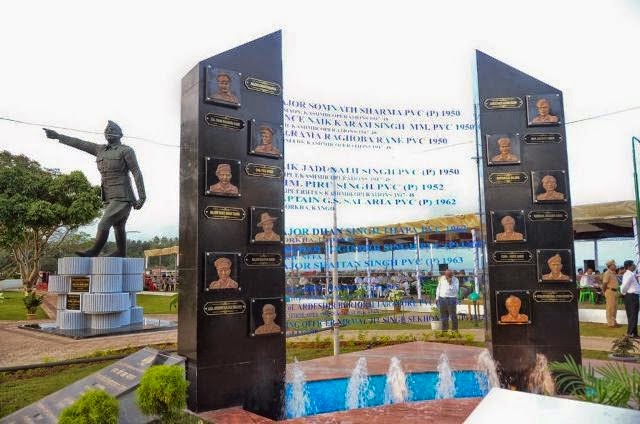
There could not be a better tribute to the brave sons of our country than the Param Vir Chakra Memorial at Marina Park, which was dedicated to the Nation by none other than the Lt Governor of A&N Islands, Lt Gen A K Singh (Retd). At a function at the Marina Park today, the Lt. Governor unveiled the beautiful memorial which carries pictures and details of all 21 Param Veer Chakra awardees. The First Lady of these Islands, Smt Suneeti Singh, Member of Parliament, Shri Bishnu Pada Ray, Smt Rupa Ray, the Commander–in-Chief A&N Command, Vice Admiral Pradeep Kumar Chatterjee, Chief Secretary, Shri Anand Prakash and the Chairperson PBMC, Shri K Ganeshan, besides PBMC councillors, PCC President, Shri Kuldeep Rai Sharma, senior officers of the Defence and Civil Administration were present.

Addressing the gathering on the occasion, the Lt Governor complimented the team of PBMC for developing an exquisitely designed memorial in the precincts of Marina Park. He said this memorial will serve as an inspiration through the bravery, valour and the supreme sacrifice made by India's brave sons. The Lt Governor said that Param vir Chakra is awarded to the personnel of Armed Forces for most conspicuous bravery or pre-eminent act of valour or self sacrifice made in the presence of the enemy whether on land, at sea or in the air.

Param Vir Chakra Memorial Dedicated to the Nation
The Lt Governor opined that being a soldier is a most honourable way of serving the Nation. And in the profession of Arms the PVC awardees are the most exalted/ultimate heroes.

The Lt. Governor said the National Memorial Cellular Jail is a mute testimony to the sacrifices made by our freedom fighters in the pre-independence period while the PVC memorial will remind the people about the bravery and sacrifice of our brave hearts in the post Independence era. The Lt. Governor described the patriotic feelings and the nationalistic fervour prevailing among the islanders as unmatched. He also narrated few lines of the song of the Army i.e “kadam Kadam Badaye ja khusi ke geet gaye ja …. Ye zindagi hai Kaum ki tu Kaum pe mitaye ja”…

Param Vir Chakra Memorial Dedicated to the Nation
The Lt Governor narrated some of the exploits and his interactions with the PVC heroes. He also narrated the chetwoode motto, which is a guide for all Army officers: The chetwoode Motto: “The safety, honour and welfare of your country come first always and everytime; the honour, welfare and comfort of the men you command comes next; your own case, comfort and safety come last, always and everytime”. The Lt Governor concluded his speech by saying “on behalf of the Islanders, I salute these brave hearts, the ultimate heroes of our Nation”.

The Lt Governor also released an information brochure brought out by the PBMC, giving details of various services offered.
Param Vir Chakra Memorial Dedicated to the Nation

In his address on the occasion, the Member of Parliament, Shri Bishnu Pada Ray expressed his happiness over the erection of the memorial which was so aptly conceived by out Lt Governor and which will always inspire the youth of these Islands about the brave soldiers of our country, some of who had made supreme sacrifices to the cause of the motherland. The MP enlightened the gathering about the historical past of the Gymkhana ground, currently Netaji Stadium, where Netaji Subhash Chandra Bose unfurled National Tri - colour declaring these Islands independent from the shackles of the Britishers. He also appreciated the PBMC for bringing out the Information brochure which mentioned a clear cut time frame about the services to be provided to the city dwellers.

In his speech on the occasion, the Commander–in-Chief A&N Command, Vice Admiral Pradeep Kumar Chatterjee also expressed his happiness on setting up the PVC memorial glorifying the brave hearts of the Armed Forces. He said the site selected for the memorial is pristine and apt. The CINCAN further stated that PVC is the highest gallantry award for the country. He noted with appreciation that patriotism is entrenched in the DNA of the Islanders and with the construction of memorial, the Islanders have shown their respect to the valiant men of the Armed Forces.

The Chief Secretary, Shri Anand Prakash described the occasion as a momentous one. These Islands are deeply associated with the freedom struggle and the PVC memorial at the Marina Park is surely going to inspire the young generation and the tourists as well, the Chief Secretary added.

Param Veer Chakra Memorial

Param Vir Chakra Memorial Dedicated to the Nation

Welcoming the chief guests and others present on the occasion, the Chairperson PBMC, Shri K Ganeshan said that the sacrifices made by the freedom fighters to the cause of the motherland has made these Islands a place of pilgrimage. He further said that PBMC team had worked hard to actualise the vision of our Lt Governor. The function concluded with the vote of thanks proposed by the Secretary PBMC, Shri S P Singh.

Param Vir Chakra Memorial dedicated to the nation

A memorial built as a testimony to the sacrifices made by soldiers has been dedicated to the nation at the Marina Park here.

The memorial was dedicated to the nation by Andaman and Nicobar Islands Lieutenant Governor Lt Gen A K Singh (Retd). Param Vir Chakra, India's highest gallantry award, is awarded to officers and enlisted personnel of all military branches for the highest degree of valour and self-sacrifice in the presence of the enemy and may be awarded posthumously.

The memorial would serve as an inspiration to the Indian youth about the bravery, valour and the supreme sacrifices made by the country's brave sons, Singh said. Expressing hope that this memorial would invigorate feelings of courage and love for the country among the youth of India, the Lt Governor complimented the Port Blair Municipal Corporation for developing the memorial.

While Cellular Jail in the islands is a testimony to the sacrifices made by our freedom fighters, this memorial will remind the people about the sacrifices made by our brave hearts in the post Independence era, he said. 

In his speech on the occasion, the Commander–in-Chief A&N Command, Vice Admiral Pradeep Kumar Chatterjee said patriotism is in the DNA of the islanders and with the construction of this memorial, they have shown their respect to the valiant men of the nation.

Source : DNA

Bravest of Brave Indian Soldier Abdul Hamid PVC

A soldier in the 4th Grenadiers of the Indian Army, he destroyed 7 Patton tanks of the enemy and went down fighting in the Khem Karan sector during the Indo-Pakistan War of 1965


Emblazoned on one wing of an army building in the Cantonment area of Bangalore was the name, ‘Abdul Hamid Barracks’. A few years ago, due to renovation perhaps, the placard was removed. Who was Abdul Hamid, I asked myself. He was, it was apparent, a great soldier who had served his country faithfully and well. A little research yielded the moving and inspiring story of a very brave man — a modern-day hero.

Company Quarter Master Havildar Abdul Hamid was a soldier in the 4th Grenadiers, Indian Army and went down fighting in the Khem Karan sector during the Indo-Pakistan War of 1965. Even as a child, he was no stranger to the traditions and rigours of army life. His father was Lance Naik Usman Farooqi.

In 1965, when war broke out between India and Pakistan, Abdul Hamid had already completed ten years of service in the Indian army and won the Saniya Seva medal, Samai Seva medal and the Raksha medal. The enemy’s offensive was aimed at Aknoor in Jammu. Their goal was to cut off communication and supply routes to the Indian forces on the border of Jammu and Kashmir. The 4th Grenadiers occupied a vital area near Chima village on the road to Khem Karan. Firm hold of this area was essential for the Indian plan of defence. On September 8, the enemy made repeated attacks on the Grenadiers’ position, but was repulsed each time. The most serious assault came when the enemy advanced with a regiment of Patton tanks. So intense was the attack that a shell littered every yard of ground occupied by the Indian battalion. Hamid was in command of a recoilless gun detachment. He moved out to a flank with his gun mounted on a jeep.


Intense enemy firing did nothing to deter him. From his new position he knocked out the leading tank with accurate fire. Then changing position, he disabled another. By now the enemy had spotted him and employed machine guns and explosives to bring him down. As he hit another enemy tank, he was mortally wounded by a high explosive shell.

Throughout this blistering attack, he had inspired his comrades to put up a gallant fight. The enemy was routed. They never made it past Khem Karan. Approximately 97 Pakistani tanks were destroyed or abandoned during this battle.

Abdul Hamid did not live to see the next day or share in the joy of victory that came after three days of intense fighting. He was awarded the highest military honour, the Param Vir Chakra, posthumously. His citation gives him credit for destroying three tanks. He had in fact destroyed seven.

Today he lies in a modest grave at a place commemoratively called Assal Uttar (‘Befitting Reply’). A fading plaque records his heroic deeds. He had stood up single-handedly in India’s most famous win in the 1965 War. According to the caretaker there, only a handful of visitors come on his death anniversary every September 10.

One can make a note some important developments, though. This decisive win exposed the vulnerability of the M 48 Patton Tanks. They had been supplied by the United States to Pakistan. They were withdrawn completely and replaced with M60 Patton Tanks. India set up a War Memorial in Khem Karan, where the captured Patton tanks are displayed.
 

भारतवर्ष के वीर सपूत अब्दुल हमीद, जिन्होंने अकेले दम पर पाकिस्तान के 7 टैंक नष्ट किये थे, के शहादत दिवस (10 सितम्बर ) शत-शत नमन
A stamp was issued in Hamid’s honour in 2000. A television serial featuring Naseeruddin Shah was also produced. But by and large, today Hamid is a forgotten hero. His spirit fortunately lives on. Very few are probably aware that the intrepid social activist, Anna Hazare, was present and active during this period of valour and glory. A comrade of Abdul Hamid, his assignment was to carry firearms and bombs to the border. In the fierce engagement all his fellow-soldiers became martyrs. He was the only survivor. It was an experience that affected him profoundly, making ‘Service to the Nation’ the moving force of his.  Article by -- Leela Ramaswamy

Story of Param Vir Chakra Awardee Veer Abdul Hamid

Abdul Hamid was born on 1 July 1933 in Dhamupur village of district Ghazipur in Uttar Pradesh to Sakina Begum and Mohammad Usman, who had three more boys and two girls. Abdul’s father was a tailor by profession and Abdul would often help him stitch clothes before he decided to join the Army.

Hamid was 20 years old when he was recruited at Varanasi into the Army. After undergoing his training at the Grenadiers Regimental Centre at Nasirabad, he was posted to 4 Grenadiers in 1955. Initially, he served in a rifle company and was then posted to a recoilless platoon. He fought in the ’62 war in Thang La, then in the North-East Frontier Province, as part of the 7 Mountain Brigade, 4 Mountain Division, and came back disappointed with the war. After ceasefire was declared his unit moved to Ambala where Abdul was appointed Company Quarter Master Havildar (CQMH) of an administration company.

When Pakistan attacked in the Rann of Kutch area in April 1965, 4 Grenadiers was ordered to move forward and to collect their 106 RCL guns from the nearest ordnance depot. Hamid was one of the non-commissioned instructors. Due to absence of anti-tank detachment commanders, he was told to take over an antitank detachment. A very good marksman and an expert anti-tank gunner with a new anti-tank gun at his disposal, he made a big difference to the outcome of the war.

Khem Karan Sector: 8 September 1965, 9 am

The fields are rustling with sugar cane and even as Hamid sits in the passenger seat of his jeep, which has mounted on it a recoilless (RCL) gun, he can hear the wind. The jeep trundles over a narrow mud track ahead of Cheema village. Hamid knows Pakistan has launched an attack with a regiment of Patton tanks that has barged right into the forward position. He hears the rumble of armour first and then catches sight of a few tanks that are heading towards his battalion.

Taking cover behind the tall crop, Hamid points his gun in their direction and then waits. The Grenadiers hold their fire so as not to warn the enemy. Just as the tanks come within 30 yards, Hamid asks his loader to load the gun and shoot. He watches the shell go up and arch towards the first enemy tank. Even as he picks up his binoculars, he hears the blast. The tank is burning in front of his eyes.
Hamid and his men rejoice. ‘Shabaash!’ Bravo, he mouths and they exchange wide smiles. They spot the crew of the two following tanks dismount and run away. Hamid orders the driver to reverse and move. Around 11.30 am, the battalion is subjected to heavy artillery shelling and then they hear the familiar rumble again. Hamid whips out his binoculars. Three more tanks are heading in their direction.

He positions his jeep in the midst of the field to hide it from view and, positioning his gun, waits. The moment the tank comes within shooting distance, he signals to the loader and watches the trajectory of the shell. It hits target and one more tank is burning in front of his eyes while the remaining two are again abandoned by the Pakistanis.

By the end of the day, Hamid has destroyed two tanks while four have been abandoned.
Demands are now made on the engineers to lay out anti-tank mines in the area since that is where the enemy tanks are coming in from. They do the best they can under the time available. It is clear that the battalion is facing a brigade-level attack from the Pakistani armoured forces and all they have to fight them with are RCL guns. That doesn’t bother the soldiers who are in high spirits after their initial victories.

The next morning Hamid is back at his job and he destroys two more tanks with his RCL gun. The battalion also faces an air attack from Pakistani Sabre jets but these don’t do much damage. By the end of the day, Hamid and his team have shot down two more tanks. It is a remarkable achievement. That night Abdul Hamid sleeps well. He is happy with his achievement. His citation has been sent for a Param Vir Chakra (PVC). It credits him with the destruction of four tanks.
The next day Hamid shows up on the battlefield yet again.

He will destroy three more tanks (according to his grandson Jameel, who has heard about the battle from a survivor, who died a few years ago). This, however, will not get entered into his records since his citation has already been sent.

10 September 1965

4 Grenadiers comes under heavy enemy shelling. After that there is another assault by enemy tanks. They are moving in a formation of three. Hamid waits under cover of vegetation and when the first tank gets close, he blows it up, quickly asking his driver to move away. Just as they do, a tank shell drops and explodes at the very spot where they were a few minutes ago.

The brave Grenadiers have moved to another point behind a thicket from where they are training their gun on another Patton. They shoot it down as well. By now, the shelling has started. The enemy tanks have noticed the jeeps and they concentrate machine-gun fire on them. Hamid is tricking them by constantly changing his position and by keeping his jeep camouflaged by the tall sugar cane crop. Another tank slowly lumbers towards him, but he does not have the time to move since they have both spotted each other.

Both place each other in their sights and shoot. Both shells hit their targets. There is a loud blast, fire and smoke. Even as the tank is blown up, its shell hits the jeep. The impact flings it in the air. There are screams of pain, a loud crash and then complete silence intercepted only by the crackle of flames.
Hamid is dead. He has blown up a total of seven enemy tanks, even more than an armoured formation can hope for. For his remarkable achievement, bravery and courage, Hamid is awarded the PVC posthumously. The battalion is awarded the Battle Honour of Asal Uttar and the Theatre Honour (Punjab). For the first time in military history, a battalion with only RCL guns at its disposal has fought off an armoured division.

Source  - Tehalka 

The Brave : Param Vir Chakra Capt. Gurbachan Singh Salaria

Two bullets had pierced his neck. The blood was seeping down and soaking his shirt. Right ahead he could see the gendarmerie running away. Some of his brave and gutsy Gorkhas were still giving chase.

He did not resist when an immense weariness enveloped him. He had lost too much blood. His task had been achieved and he was at peace. Closing his eyes, Capt Gurbachan Singh Salaria of 3/1 Gorkha Rifles, dropped his rifle and fell, drifting into unconsciousness from which he would never awaken.


Param Vir Chakra Winner Capt Gurbachan Singh Salaria
Many years earlier, when Salaria had joined the Gorkha Rifles, he had been told that his regiment’s motto was: It is better to die than to be a coward: Kafar hunu bhanda marnu ramro.

Salaria had lived up to the motto. Salaria fancied himself a palmist. Before the Congo deployment in February 1961, he had visited Chotta Shimla for some work and run into an excise officer, who used to read people’s palms.

Reading Salaria’s hand, the officer told him that there was a star on his mount of Jupiter, which would bring him great fame. Salaria took the prediction very seriously and would often point it out to fellow officers in lighter moments.

Maj Gen RP Singh recalls Salaria showing him his own right hand. He pointed out the star on his mount of Jupiter. ‘Wait and see, this star will take me to great heights,’ he said. Singh had leaned over to feel the mount, but only out of politeness. ‘I just shrugged it off as I never took his knowledge of palmistry seriously,’ the general recounts.

‘I did not know that his day of reckoning and attaining fame was just a few days away. Or that he would never know of this fame since it would come when he was in his heavenly abode,’ he says quietly.

Gurbachan Singh Salaria was born on 29 November 1935 in a village called Janwal, near Shakargarh, now in Pakistan. The second of five children, he was a favourite of his grandmother, who would tie a black thread around his waist to keep the evil eye away from him.

Gurbachan’s father Munshi Ram was in the Armoured Corps of the British Indian Army and would move from one Army cantonment to another, coming home only on annual or casual leave.

When he did come home, it was celebration time. Friends and family would drop in to listen to his awe-inspiring tales of faraway places where soldiers performed great acts of bravery. Little Gurbachan and his siblings would listen to their father in rapt attention. Quite possibly this is how Gurbachan was inspired to be courageous.

Gurbachan would go to school regularly, but was always more occupied with games and outdoor activities rather than studying. He was a good kabaddi player, and continued to be good at sports even after he cleared the entrance to King George’s Royal Military College (KGRMC), Bangalore. Though he was initially rejected in the physical exam because his chest was found to be an inch less than the stipulated measurements, he was given a month to try again. He took the challenge head on, drinking one litre of goat’s milk every day and exercising passionately.

When he went back for his medical, he had managed to increase his chest by two-and-a-half inches and was immediately admitted. He joined the college in August 1946 as a cadet. In 1947, he was transferred to KGRMC Jullundur, which was closer to his village.

When he was in his second year, Gurbachan and a friend were once bullied and insulted by another cadet. Gurbachan’s self-respect took a blow but he challenged the bully to a boxing match the next day. He boxed with such fury that the bully was knocked out and had to apologise. The operation in Congo was very reminiscent of this incident; where Gurbachan took on a much bigger and better equipped enemy fighting force just because he wanted to teach them a lesson in war ethics.

Gurbachan went on to the National Defence Academy and then the Indian Military Academy. He joined 2/3 Gorkha Rifles in July 1954 where he was nicknamed Khan Saheb by his commanding officer because of his cropped hair cut and upturned moustache.

In March 1960, he received orders, transferring him to 3/1 Gorkha Rifles. And that was where General R P Singh, who was then the battalion adjutant, met him. General Singh found Salaria to be a simple man, spartan and very careful with money, unlike other young officers, many of whom had extravagant tastes. In fact, Salaria once told him, he recalled, that he was sending money home to finance the education of his younger brother Sukhdev, at college in Jammu.

Sukhdev is now 75 and lives in Pathankot. He is bedridden and has lost his sense of balance, but he remembers fondly how, when he and Gurbachan were little boys - Gurbachan was older by two years - they would go swimming in the small stream that ran across their village.

‘We had no worries then; we would splash around in the stream. What beautiful days they were. Now Gurbachan is gone and I can’t walk, but whenever I think of him that is the first memory that streams into my head,’ says the old man, sinking back into silence. He has more memories to recount but his strength fails him.

Source : New Indian Express

The Brave - Param Vir Chakra Stories Book by Author Rachna Bisht Rawat

Soldiers don't die on the battlefield, they die the moment people stop remembering them, says a writer who has traced the lives of 21 awardees of the Param Vir Chakra (PVC), the nation's highest award for gallantry, in a book hoping it will remind people of the sacrifice these men in olive-green made for their country.


Taking one into the hearts and minds of India's bravest soldiers, "The Brave" (Penguin; Rs. 250) is former journalist Rachna Bisht Rawat's attempt to revive the journey of these lost heroes in the memories of the young and old alike.

"Emotional speeches are made and these soldiers are given heroic farewells, but after that we all forget them completely," Rawat told IANS in an interview.

"I hope children will read these stories and so will everyone because for these men, the country came first. It is important to remember their sacrifice and keep them in our memories for ever," she added.

Coming from a services background - Rawat's father and brother are in army and she is married to an army officer - identifying with the fear of "losing a family" it was easier for her to relate to their loss.
Hence began a year-long journey of meeting families of the PVC awardees.

During this period she realised that while the families might not have received highest compensation for their precious loss, they all are proud of their sons who sacrificed their lives for the country.

So whether it is India's first PVC recipient, Major Somnath Sharma who died while fighting during the 1948 India-Pakistan war or Captain Vikram Batra during the 1999 Kargil operations - Rawat has made an effort to extract personal anecdotes of their lives from their family members.

However, Rawat was not able to trace the families of two soldiers from the 1947-48 war, Naik Jadunath Singh and Company Havildar Major Piru Singh Shekhawat. Thus, she had to rely on War Diaries and other sources for her research on them.

Otherwise, "tracing the families of the soldiers wasn't difficult because army never forgets about its people. So I contacted all the units and got phone numbers from them," she said.

It was during the conversations she had with the ailing mother of Second Lieutenant Arun Khetarpal, who fell during the 1971 war, that Rawat realised that "the void in his mother's heart" hadn't gone away.

"It was evident. She didn't remember anything about her son. But the only thing she quickly remembered was how she had asked him before he left for the battlefield was to 'fight like a lion'," Rawat said.

Anecdotes like these are aplenty in the book, making it apt reading to mark the 68th Independence Day on Friday. Source : IndiaTv

The Brave: Param Vir Chakra Manoj Kumar Pandey

A new book, The Brave takes you into the hearts and minds of those who die so that we may live. Here is the story of one of them

Batalik Sector Kargil: 1999
The sun had disappeared, dropping an impregnable black quilt over the terrain. It hid the crisp green of the grass, the blue rush of the sparkling water, the mesmerizing beauty of the district; and he preferred it that way.


Daylight just added to his outrage at Pakistan’s audacity to sneak in and occupy the heights around them. Emotion interfered with resolve; tonight all he needed was cold reason and an animal's instinct for survival.

Somewhere behind him, in the gloomy darkness intercepted only by the call of crickets, the Ganasak Nala gurgled, lapping against the quiet of the still night. Ahead loomed a steep though blurred 70-degree incline.


That was Khalubar, the 5000-metre high ridge he and his men had to climb that night. Their task: to reach up undetected, take the enemy by surprise and destroy the Pakistani bunkers on top before daybreak.

Walking into a hail of bullets…
He knew not many of them were expected to return but that didn’t bother him much. He remembered the emotional words he had once scrawled in the depths of a diary he had been maintaining since childhood: Some goals are so worthy; it’s glorious even to fail. Signalling to his men to follow with a curt nod, Manoj got up, slung his gun behind him and started to walk.

For more than a month they had been on almost continuous assignments, one following the other. In the Army, they called it a rodent's life scampering up hillsides under cover of darkness, finding holes to crawl into when daylight broke, carrying on their backs 4-kg backpacks that held sleeping bags, extra pairs of socks, shaving kits and letters from home.

They would nibble on hard, stale puris when hunger struck. Though the nala was close, with its fresh water beckoning, they could never reach it because the enemy would fire from the top. Instead, they would reach into crevices to snap off icicles that they would suck greedily on to quench their thirst.

They would fill their water bottles with crushed snow for the endless rocky climbs where water would not be found and crack icicles under their teeth, swirling them around in their mouths like the coloured iced lollies from their childhood.

Manoj and his men had been climbing in miserable darkness for almost nine hours. Most of them had rolled up their jackets and shoved them into their backpacks. Manoj had a pair of spare woollen socks that he had wrapped around the breechblock of his rifle to keep it warm and lubricated and protected against jamming in the cold.

A seized weapon in war could make the difference between life and death. Though the night temperature was touching sub-zero, the arduous climb made the soldiers sweat. Manoj led his men, quick and noiseless. He would slip his fingers into cracks in the rocks and pull himself up, feeling his way ahead, deliberately keeping his mind off the fact that there could be a snake or a scorpion sitting in a crevice, ready to strike.

Climbing was a thirst-inducing business and most of the men had finished their one-litre water bottles. They found some patches of snow under larger stones. While some of it was fresh and could be picked up in greedy fistfuls to quench thirst, most of it was too contaminated by gunpowder to be of any use.


The Brave : Param Vir Chakra Stories
Author: Rachna Bisht Rawat
Publisher: Penguin Books India 
Price: Rs 250

BUY NOW

Manoj ran his tongue over chapped lips and didn't reach for water even though he was tempted. There was just one last sip left. He wanted it there for psychological support till the end. The men had been climbing for more than fourteen hours.

They hadn’t slept for twenty-four. Sudden downpours of sleet and snow had left them chilled to the bone. They had miscalculated the treacherous path, lost their way twice in the dark and it was already morning by the time they spotted the hazy outline of the top.

They had the option to go back before the enemy spotted them but Manoj made up his mind they would complete the task they had been sent for. There would not be any turning back now. They would storm the enemy bunkers, making the best of the bad weather and the wet mist creeping up the cliff s, with its cold fingers on all it found in its path.

Another volley of fire lit up the sky. Manoj knew the guns were lined up on the highway, all along the Indus, firing at least 20,000 rounds at a time. The aim was to distract the enemy, which was why he and his men had been able to climb the 70-degree incline unnoticed do far. However, this time the fire seemed to be coming dangerously close. The burst of the shells was accompanied by a hail of bullets and suddenly a soldier screamed out in pain and collapsed.

Closer to the enemy...
‘Take cover,’ Manoj shouted, ‘this looks like enemy fire.’ The bullets, rockets and machinegun fire were coming at them with an unnerving accuracy. The cries of men who had been hit rang out through the stillness of the chilly morning.

From behind the boulder where he had taken cover, Manoj looked out. Around him was death and destruction. Limbs had been torn apart, flesh ripped into, and blood was seeping into the soil as the gut-wrenching screams of his men echoed in the impersonal stillness of the bare brown mountains.

He knew they would have to storm the enemy in a daring daylight attack, right now. As soon as his mind was made up, the rush of adrenaline overcame indecision, fear and nervousness. The paralysing cold seeping into his bones was replaced by the heat of blood coursing through his veins. As the tracer bullet came flying past, lighting the place with a deadly cocktail of shrapnel and fire, Manoj stood up, tall and brave, his slight frame coiled like a spring, his face a mask.

He roared at his men that were fit to fight, ordering them to follow him through the hail of bullets. Like a colossal god with invincible powers he walked into the curtain of shells and bullets. He didn't look back even once to see who had followed his final command but if he had he would have been a satisfied man.

All his Gorkha jawans who could pick themselves up and walk were right behind him, their khukris gripped firmly in their hands. Leaving behind those dead or dying, the men charged like angry lions, placing their feet firmly on the sleet-covered jagged rocks, following the man, who was not walking through flying bullets for the first time. They had seen him do it before. Just about a month ago.

The time is here...
The time has come to show that daring once again and Manoj does not disappoint his men. Adrenaline coursing through his veins, he gestures to them to follow and, steeling his heart against every instinct for self-preservation, walks into the curtain of flying bullets to reach the first bunker on the ridge a pile of cut rocks with a boulder for a roof, grainy in the brooding fog that is sweeping across the landscape.

He can make out the shadowy outlines of two Pakistani Northern Light Infantry soldiers. He is not conscious of an effort but a sharp tug at his belt apprises him that his hand has gripped the handle of the khukri hanging there and whipped it out in a silken move. The sheath falls away limply by his side as his hand fl ashes its ferocious blade up in the chilly wind.

The thumping of his heart is left behind in an instant as he runs across the uneven terrain, jumping over boulders in the falling snow, his face a grotesque mask of death, and falls upon the enemy soldiers, ferocious and proud. There is a swish in the air as the blade, cutting through the falling snowflakes, flashes and slices into human flesh.

Right to left, left to right. Then again. And again. The bodies of the shocked Pakistanis, terror written in their eyes, fall in a bloody pile. They could have never imagined that someone would walk in through the deadly fire. Had he been watching, the young officer's regimental centre khukri ustad would be proud of his student as he lets the blood drip off his khukri and looks up to find his next target.

Sprinting across to the second bunker, the men fiercely pounce upon the enemy and a bloody hand-to-hand combat follows, ‘Jai Mahakali, Aayo Gorkhali’ piercing the cold morning. Return shots ring out. Some of the enemy soldiers are charging with their bayonets, but most found they are no match for the gutsy Gorkhas with their lethal khukris that are splashing blood on the wet rocks. Suddenly, Manoj winces.

He has been hit in the shoulder by a bullet. Unconcerned, and feeling no pain in the heat of the moment, he takes out his gun and moves on to the next bunker, spraying the ones hiding there with a shower of bullets. Another bullet comes and hits him in the leg, making him stagger unsteadily.

‘Naa chodnu,’ (Don’t leave them) he cries out in Gorkhali, telling his men to carry on the carnage, and drags his injured leg forward. Reaching out for a grenade, he lobs it at the fourth bunker from where mortar fire is coming at them.

Even as an explosion rents the sky, throwing up a dull grey cloud of stone and debris, a fatal shot bursts through the air and hits the officer in the forehead. There is a flash of yellow and he is engulfed by the smell of burning cordite and a warmth in the freezing cold. His whole body is wracked by a terrible pain; his brain is on fire, his lungs gasping for breath, his heart seems to want to force itself out of his chest and his tongue is dry and swollen with thirst.

He wants to go on and shoot the Pakistani soldier he can see leaping out of the burning bunker and race down the slope, but his disobedient body had stopped listening to his commands. He can only watch as his arms let go of the rifle he has been holding, his fingers lose their grip on the trigger, his knees buckle under him and his neck slumps forward on his heaving chest. Blood courses down his face, blurring his vision.

There is a spurt of light in his head, then stark darkness and silence. Finally, he has to close his eyes. Manoj Kumar Pandey of 1/11 Gorkha Rifles is dead; his blood-stained body tilts in an arch and falls gently to the ground in front of the fourth bunker of Khalubar. He is 24 years and seven days old.

About six years ago...
On a warm, sultry summer afternoon, a thin boy with a side parting in his hair and shiny new leather shoes walked down for his service selection board interview for NDA.

He was trying to keep his mind off the bite in his toes, the sting of the cheap elastic in his socks and the guilt he had felt asking his poor father for money to buy them. He reminded himself that he was the best NCC cadet in his state and desperately hoped that his basic knowledge of English would not desert him during the interview.

‘Why do you want to join the Army?’ the interviewing officer was stern and abrupt, and looking straight into his eyes. ‘I want to win the Param Vir Chakra,’ he replied returning the stare, hoping the sentence was grammatically correct. The interviewing officer looked at the others on the board and exchanged a smile.

Sometimes, they say, there is magic in the air and we must be careful about what we say because it will come true. Not only did young Manoj Kumar Pandey from Sitapur district in Uttar Pradesh get into NDA, he also won the Param Vir Chakra, the Armed Forces’ highest gallantry award. Unfortunately, he hadn’t said he wanted to wear it live.

Article & Image Source @ Mid-Day

Param Veer Chakra recipients of India-Pakistan war 1971

 Param Veer Chakra recipients of India-Pakistan war 1971

S NO RANK NAME REGIMENT AWARD
1 2/LIEUTENANT
      
ARUN KHETARPAL      
17 horse PARAM VIR CHAKRA      (P)
2 MAJOR
     
HOSHIAR SINGH
3 GRENADIERS PARAM VIR CHAKRA     
3 LANCE NAIK
     
   ALBERT EKKA
14 GUARDS PARAM VIR CHAKRA  (P)
4 2 /LIEUTANANT SS  SAMRA 8 GUARDS MAHA VIR CHAKRA       (P)
5 SUBEDAR MALKIAT SINGH 14 PUNJAB MAHA VIR CHAKRA       (P)
6 LANCE NAIK RAM UGRAH PANDEY 8 GUARDS MAHA VIR CHAKRA       (P)
7 RIFLEMAN PATI RAM GURUNG 5/1 GORKHA RIFLES MAHA VIR CHAKRA(P)
8 LIEUTENANT COLONEL HHS BHAWANI SINGH 10 PARA MAHA VIR CHAKRA
9 MAJOR DALJIT SINGH NARAG 45 CAVALRY MAHA VIR CHAKRA(P)
10 RIFLEMAN DIL BAHADUR CHETTRI 4/5 GORKHA RIFLES MAHA VIR CHAKRA
11
JOGINDER SINGH GHARAYA, KC, VSM BIHAR MAHA VIR CHAKRA
12 LIEUTANANT COLONEL PREM KUMAR KHANNA 5 SIKH MAHA VIR CHAKRA
13 MAJOR ANUP SINGH GAHLAAT 3 DOGRA MAHA VIR CHAKRA(P)
14 MAJOR BASDEV SINGH MANKOTIA 9 PUNJAB MAHA VIR CHAKRA
15 SUBEDAR MOHENDER SINGH 18 PUNJAB MAHA VIR CHAKRA
16 SEPOY PANDURANG SALUNKHE 15 MARATHA LIGHT INFANTRY MAHA VIR CHAKRA (P)
17 BRIGADIER ANANT VISHVVANATH NATU 9 GORKHA RIFLES MAHA VIR CHAKRA
18 LIEUTANANT COLONEL RAJ KUMAR SINGH 14 PUNJAB MAHA VIR CHAKRA
19 MAJOR JMVIR SINGH 5 SIKH IVIAHA VIR CHAKRA
20 MAJOR KULDIP SINGH CHANDPURI 23 PUNJAB MAHA VIR CHAKRA
21 MAJOR CHEWANG RINCHEN, MVC LADAKH SCOUTS MAHA VIR CHAKRA
22 BRIGADIER KRISHNA SWAMI GOWRI SHANKAR SIGNALS MAHA VIR CHAKRA
23 LIEUTENANT COLONEL KASHMIR! LAL RATTAN 6 SIKH MAHA VIR CHAKRA
24 LIEUTENANT COLONEL RATTAN NATH SHARMA 21 PUNJAB MAHA VIR CHAKRA
25 LIEUTENANT COLONEL SURRINDER KAPUR 1 JAMMU AND KASHMIR RIFLES MAHA VIR CHAKRA
26 CAPTIAN PRADIP KUMAR COUR 660 AOP SQUADRON ARTILLERY MAHA VIR CHAKRAT)
27 LIEUTENANT COLONEL CHITOOR VENUGOPAL 5/1 GORKJ4A RIFLES MAHA VIR CHAKRA.
28 MAJOR VIJAY RATTAN CHOWDHARY 9 ENGINEERS MAHA VIR CHAKRA (P)
29 LANCE NAIK DRIG PAL SINGH 15 RAJPUT MARA V/R. CHAKRAIP
30 LANCE NAIK NAR BAHADUR CHHETRI
MAMA VIR CHAKRA
31 BRIGADIER MOHINDER LAL WHIG 5 GORKHA RIFLES MAHA VIR CHAKR
32 LIEUTANANT COLONEL HARISH CHANDERA PATHAK 8 SIKH LIGHT INFANTRY MARA VIR CHAKRA
33 LIEUTANANT COLONEL KULWANT SINGH PANNU 2 PARA AriAHAVIR CHAKM
34 MAJOR DHARAM V1R SINGH 8 GRENADIERS MAHA WI CHAKRA
35 COLONEL UDAI SINGH 8 GORKHA RIFLES MARA VIR CHAKRA
36 LIEUTANANT COLONEL SUKHJIT SINGH SCINDE HORSE MAHA VIR CHAKRA
37 BRIGADIER SANT SINGH, MVC SIKH LIGHT INFANTRY MAHA VIR CHAKRA
38 BRIGADIER HARDEV SINGH KLER, AVSM SIGNALS MAHA V1R CHAKRA
39 BRIGADIER ANTHONY HEROLD EDWARD MICHIGAN GRENADIERS MAHA VIR CHAKRA
40 LIEUTANANT COLONEL VED PRAKASH GHAI 16 MADRAS MAHA VIR CHAKRA (P)
41 CAPTAIN SHANKAR SHANKHAPAN WALKAR 18 MADRAS MAHA VIR CHAKRA (P)
42 HAVALDAR BR BAHADUR PUN 5/1 GORKHA RIFLES MAHA VIR CHAKRA
43 HAVALDAR THOMAS PHILIPOSE 16 MADRAS MAHA VIR CHAKRA
44 LANCE NA1K SHANGARA SINGH 2 SIKH MAHA VIR CHAKRA (P)
45 LIEUTANANT COLONEL VED PARAKASH AIRY 3 GRENADIERS MAHA VIR CHAKRA
46 LIEUTANANT COLONEL RAJ MOHAN VOHRA 4,HORSE MAHA VIR CHAKRA
47 LIEUTANANT COLONEL HANUT SINGH 17 HORSE MAHA VIR CHAKRA
48 MAJOR AMAJIT SINGH BAL 17 HORSE MAHA VIR CHAKRA
49 BRIGADIER JOGINDER SINGH BAKSHI JAT MAHA VIR CHAKRA
50 SEPOY ANSUYA PRASAD 10MAHAR MAHA VIR CHAKRA (P)
51 BRIGADIER ARUN SHRIDHAR VAIDYA, MVC,AVSM 9 HORSE MAHA VIR CHAKRA
52 CAPTAIN DEVINDER SINGH AHLAWAT 10 DOGRA MAHA VIR CHAKRA(P)
53 LIEUTENANT COLONEL SHAMSHER SINGH 8 GUARDS MAHA VIR CHAKRA
54 MAJOR VIJAY KUMAR BERRY 4 PARA MAHA VIR CHAKRA
55 BRIGADIER ANAND SARUP 8 GORKHA RIFLES MAHA VIR CHAKRA
56 NAIK SUGAN SINGH 7 RAJPUTANA RIFLES MAHA VIR CHAKRA (P)
57 BRIGADIER KAILAS PRASAD PANDEY ARTILLERY MAHA VIR CHAKRA
58 LIEUTENANT COLONEL NARINDER SINGH SANDHU 10 DOGRA MAHA VIR CHAKRA
59 LIEUTENANT COLONEL ARUN BHIMRAO HAROLIBAR 4/5 GORKHA RIFLES MAHA VIR CHAKRA


Indian Defence Gallantry Awards

 Indian Gallantry Awards


PARAM VIR CHAKRA :


PVC is the highest decoration of valour awarded for the most conspicuous bravery or some daring or prominent act of valour or self-sacrifice in the presence of the enemy on land,sea or air.

MAHA VIR CHAKRA :

It is the second highest decoration. It is awarded for acts of conspicuous gallantry in the presence of the enemy, whether on land, at sea or in the air.

VIR CHAKRA :

It is the third in the order of awards for acts of gallantry in the face of the enemy on land,sea or air.

ASHOK CHAKRA :

Awarded for the most conspicuous bravery or some daring act of valour or self-sacrifice on land, at sea or in the air.

KIRTI CHAKRA :

Awarded for conspicuous gallantry.

SHAURYA CHAKRA :

Awarded for an act of gallantry.

PARAM VISHISHT SEWA MEDAL :

Awarded in recognition of distinguished service of the most exceptional order.

ATI VISHISHT SEWA MEDAL :

Awarded in recognition of distinguished service of an exceptional order.

VISHISHT SEWA MEDAL :

Awarded in recognition of distinguished service of a high order.

SENA MEDAL / NAU SENA : MEDAL/VAYU SENA MEDAL

For good work on the field, at sea or in the air.


Gallantry Awards (War)
  1. Param Vir Chakra
  2. Maha Vir Chakra
  3. Vir Chakra
  4. Vayusena Medal
Gallantry Awards (Peace)
  1. Ashoka Chakra
  2. Kirti Chakra
  3. Shaurya Chakra
Service Awards
  1. Param Vishist Seva Medal & Sarvottam Yudh Seva Medal
  2. Ati Vishist Seva Medal & Uttam Yudh Seva Medal
  3. Vishist Seva Medal & Yudh Seva Medal


Haryana raises annuity of Param Vir Chakra winners


In a windfall for Haryanviz serving in the Indian defence forces, Haryana government has announced a financial assistance of Rs 2 crores to a Param Vir Chakra recipient  or his family and  Rs 1 crore to a Maha Vir Chakra recipient. Param Vir Chakra and Maha Vir Chakra were earlier being given Rs 31 lakh and Rs 21 lakh, respectively.


Similarly, a steep hike has also been announced in grant of monetary benefits to the recipients of all other service medals. The awards have two components - a onetime payment and the the annuity, a recurring sum given to all recipients every year. The onetime enhanced payment will be given to all soldiers receiving the awards in future while the increase in annuity will be across the board for everyone.

The financial benefit given by Haryana becomes the highest to be paid by a state government in the country. 
Punjab pays a fixed amount of Rs 30 lakh to PVC and Ashok Chakra recipients, Rs 20 lakh to MVC and Kirti Chakras winners and Rs 15 lakh for Vir Chakra and Shaurya Chakras recipients. Sena medal award amount for gallantry is Rs 7 lakh. These financial awards are applicable to those decorated after 2002. In Punjab the recipients prior to 2002 only get an annuity ranging from Rs 23,100 for a PVC to Rs 6,440 for a Shaurya Chakra.

The government will also give enhanced financial assistance to the World War-II veterans, their widows and ex-servicemen and their widows. The recipients of Yudh Sewa medal, Vishisht Sewa medal, Sarvottam Yudh Sewa medal and other medals too will be given higher financial rewards